

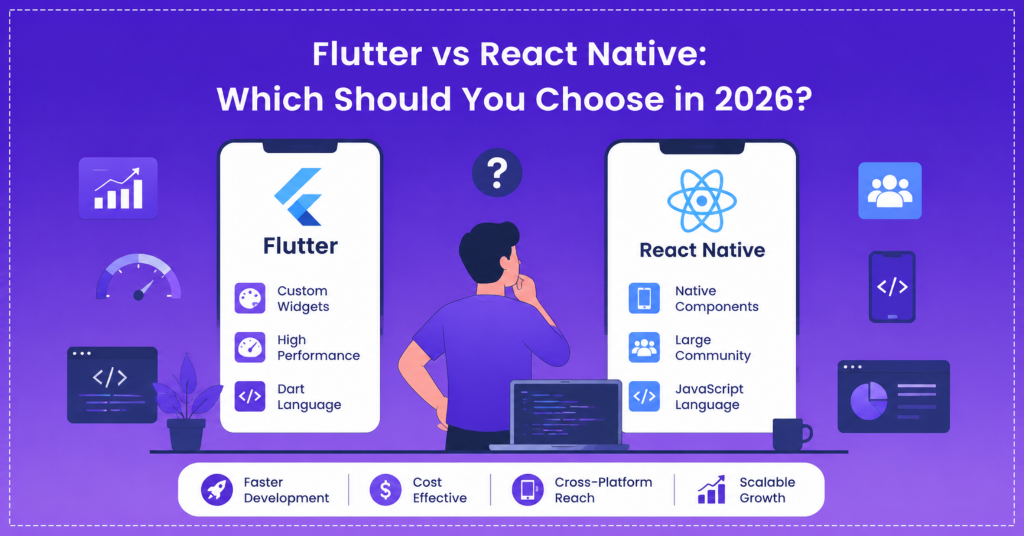
Every business wants to be at the top and run with minimal costs. For this reason, cross-platform app development is the preferred option of founders. It enables you to build a single app that will perform perfectly on Android and iOS.This is twice as expensive and twice as time-consuming to be done on each platform, one after another.
As a result, companies prefer to create cross-platform applications. It enables you to write your code and run it everywhere. The question that comes to mind again and again, however, is: Flutter or React Native, which is the best option for your business this year?
There is a substantial change in both by 2026. Don’t rely on old reviews online for your website. Let’s deep dive into it.
2. What are Flutter and React Native?
Let’s understand the basic os these two:
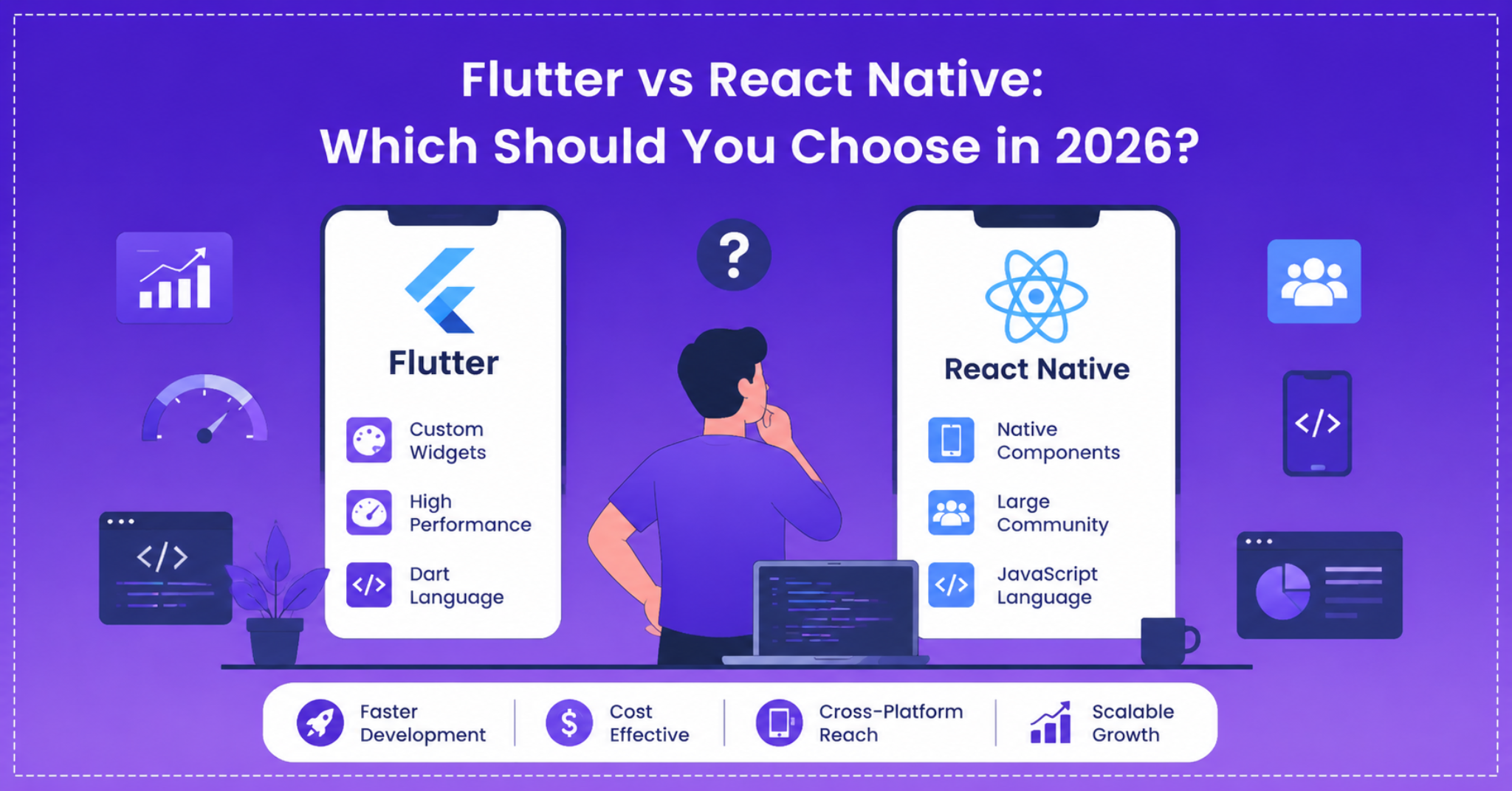
The name of Google’s toolkit is Flutter. Written in Dart, which is a programming language. Instead of using the built-in UI elements of the phone, Flutter uses those made for itself. Instead, each button, pixel and menu is individually loaded. It’s a very scalable video game engine for common applications.
React Native is a product of Meta (Facebook). It is programmed in JavaScript, which most Web developers are well acquainted with. This is not similar to Flutter, as Flutter is a virtualised version of the phone. In React Native, a button is just a button; on an iPhone, it’s a physical button, on a Samsung, an Android button. A leading react native app development company can develop apps that are just as natural to the device.
3. Flutter vs React Native: Full Comparison
Here are their side-by-side comparisons:
Feature | Flutter | React Native |
Language | Dart | JavaScript / TypeScript |
UI Approach | Widgets drawn by Flutter (Custom widgets) | Native device components |
Flutter vs React Native Performance | Very high and steady 120FPS | A native feel, extremely quick |
Community Support | Massive, driven by Google | Huge, driven by Meta & web devs |
Ideal For | Custom designs, heavy graphics | Content apps, fast MVPs |
4. What’s Changed in 2026: New Architecture and Impeller
Tech doesn’t rest. Both of them corrected major issues in history recently.
There was a slow “bridge” between JavaScript and the phone in the past in React Native. The new architecture of React Native has been completely implemented. It introduces a new bridge in the name of JavaScript Interface (JSI). This will enable direct access to the phone’s system. It enables lists to scroll smoothly, and animations are fluid.
Flutter had another problem: the initial animation stuttered on iOS, which is called “shader compilation jank. To remedy this, Google has introduced a new rendering engine called Impeller. It pre-compiles graphics and will maintain a fixed 120Hz smooth refresh rate on current devices.
Today, performance is not a big deal for either Flutter or React Native, so when considering the pros and cons of Flutter vs react native, this is not a major concern.
5. Real-World Success Stories
Both of these are used by large companies for billion-dollar operations.
If you are into Flutter, then check out Google Pay and Alibaba. Google Pay made the transition to its worldwide app with Flutter and saved a ton of engineering effort. The app is able to process millions of secure transactions every day in India without any glitches.
In the case of React Native, check out Instagram and Shopify. Shopify completely refocused its mobile efforts on React Native. Shopify completely transitioned its mobile efforts to React Native. It allows them to do so without any hassles – they can share their code from their big web dashboard to their mobile apps.
6. Beyond Flutter vs React Native: Is Cross-Platform Even Right for Your Business?
Cross-platform saves are great for time, but not all the time. In some cases, you need to use standard hybrid app development, Web Apps or even pure native apps (in Swift and Kotlin).
If you’re creating something that’s going to be a complex 3D graphical, a heavy mobile game, or an application that makes a lot of use of the phone hardware, such as Bluetooth sensors, build native. For 90% of business apps, such as e-commerce, food delivery, FinTech and SaaS, cross-platform is the best financial decision.
7. Flutter vs React Native vs Other Frameworks
Let’s see the difference between the following:
Feature | Flutter / React Native | Kotlin Multiplatform (KMP) | PWA (Web Apps) |
Code Shared | UI & Logic (~90%) | Logic only (~60%) | 100% (Runs in browser) |
Performance | Near-Native | Pure Native | Average |
Time to Market | Very Fast | Medium | Fastest |
App Store Presence | Yes | Yes | No (Runs via link) |
If you require an effective company tool, you can help determine whether you require a mobile framework or a web-first strategy by pairing with a complete and expert custom software development company.
8. Cost Breakdown: Initial Development and Post-Launch Maintenance
For most of the businesses in India, the budget is a crucial factor. Let’s get to know how it affects your pocket.
Flutter App Development Cost
The first app development with Flutter is very effective. The developers create layouts quickly, as it provides a complete library of widgets. If Google makes significant changes to the Dart language, though, there may be a little more to maintain in the long term.
React Native App Development Cost
The first app development cost is quite affordable, as there are plenty of skilled developers in React Native. Generally, JavaScript is a global standard, which makes its maintenance more affordable. You’ll not have to look for support in the future.
When you want to expand your team efficiently, you can hire the best of the best from a good React Native App Development Company, so you don’t go over budget.
9. How to Choose Between Flutter and React Native
Choose Flutter if:
- You wish for a highly customised, branded UI, which is the same on each and every phone.
- Your team is into strict, well-structured code environments.
- You don’t want to have to mess with native settings to get it to perform well.
- It’s time to collaborate with a committed Flutter application development business to create an interactive product.
If you prefer to use React Native, then:
- You have an in-house web team that is familiar with React or JavaScript.
- Your app is very dependent on the typical phone design.
- You want to share code between your website and mobile app.
- You want to leverage a massive ecosystem of pre-existing web plugins.
- You want to harness a large web plugin community.
Conclusion
No choice here is wrong as of 2026. Both are well-understood, stable and very fast. It depends on the skill set of the team you’re currently working with and the aesthetic of your app.
Flutter is the best option for full UI consistency and raw rendering speed. For easy scaling, tons of developers and web-ready code, pick React Native.
Looking for assistance to create the next successful digital product? Eiosys can help you create a scalable and high-performance web app or website development solution, whether you are looking for a reliable website development company or a mobile app development team.
Frequently Asked Questions
With the help of Flutter’s Impeller engine and React Native’s new architecture, the performance gap has significantly reduced. Whereas there is a slight edge for heavy graphical rendering for Flutter, React Native matches it for most of the business apps that are data-driven.
Yes, their numbers have been growing very quickly lately, though, of course, JavaScript is a much older language, which makes it somewhat easier to find web developers who know both technologies at the same time in the Indian tech market.
The answer is a big one because it’s React Native, but you can share a few lines of business logic as well using React. Still, if you go the Flutter way, your website will have to be written in Flutter web as well, but it is not considered a good solution unless you want to have a very specialised website.
Yes. Recovery is possible by identifying issues, improving content quality, fixing technical SEO problems, removing spam signals, and following Google’s best practices for user-focused content.
The best approach is to focus on sustainable SEO practices, creating helpful content, improving website experience, maintaining technical health, and staying informed about Google’s evolving search systems and AI-driven updates.