

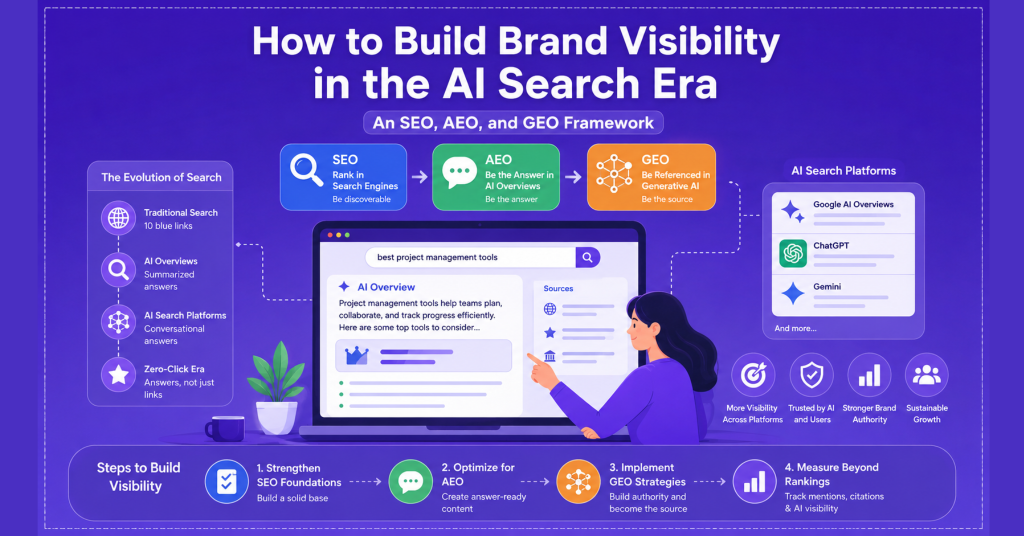
Search is changing faster than ever. Around 60% of searches the search engines result in no clicks. While traditional SEO remains a factor, it is not the only way for brands to get discovered online. Users relying more and more on AI search platforms, AI-generated answers, and Google AI Overviews for information, businesses must rethink how to build brand visibility.
The future of search engines is not limited to the ranked content. The search engines generating direct answers, summarizing information, and recommending brands to users have accelerated the rise of zero-click search experiences.
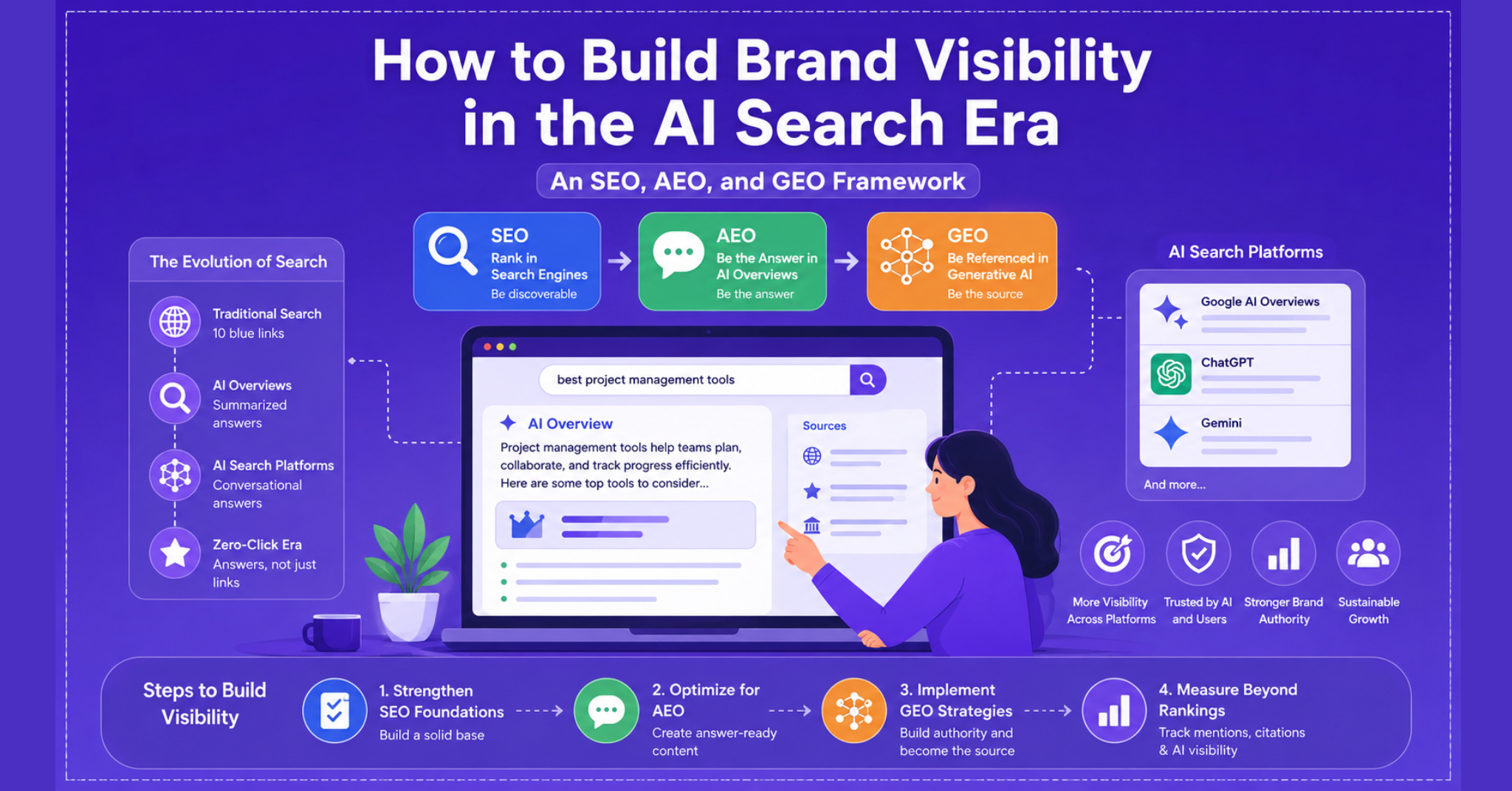
In this era, to stay visible, the brands need a framework that works with Search Engine Optimization (SEO), Answer Engine Optimization (AEO), and Generative Engine Optimization (GEO). With this approach, the brands can strengthen their presence across search engines, answer engines, and generative AI systems.
Why Google Rankings No Longer Define Brand Visibility in 2026
AI engines are decoupling brand visibility from traditional metrics like rankings and organic traffic. Although ranking factors for SEO still matter, they are no longer the only sign of visibility. Users are now interacting with Google AI Overviews, ChatGPT, Gemini, and other AI search platforms.
This change creates a new challenge for brands. You may rank high, but still lack visibility if AI-generated answers fail to discover your page. So, this changes the entire game of search visibility. Modern brand visibility depends on how often your business appears across multiple search experiences, not just traditional search results.
How AI Search Works and How Content is Selected Across SEO, AEO, and GEO
Traditionally, search engines rank webpages and present us a list of results. But now AI search works differently. When users ask a question in any AI-powered search tool, they gather information from multiple sources before generating a response. These algorithms prioritize content trustworthiness instead of relying completely on matching the keywords.
That is the reason why today, the brands are not only competing for rankings, they are competing to become the trusted source these AI search engines use while generating answers.
Businesses must balance SEO, AEO, and GEO for digital visibility across platforms. Traditional SEO helps search engines discover and rank content. Answer Engine Optimization (AEO) formats content for extraction by voice assistants and snippet tools. Whereas, Generative Engine Optimization (GEO) targets the LLM models to increase your chances of being referencedin AI generated answers.
As AI-based search continues to evolve, brands that provide trustworthy and useful content will gain better visibility across search platforms.
What Signals Matter Across SEO, AEO, and GEO? A Comparative Analysis
Signal | SEO | AEO | GEO |
Keyword relevance | High | Medium | Medium |
Search Intent | High | High | High |
Structured Content | Medium | High | High |
Backlink | High | Medium | Medium |
Brand Authority | Medium | High | Very High |
Expert content | High | High | Very High |
Modern SEO in the AI Search Era: What Still Matters And What Has Changed
Though SEO remains the foundation of digital visibility, businesses must adapt to the changing search behaviors.
Established ranking signals, such as quality content, relevant keywords, technical website performance, user experience, and a strong backlink profile, still guide your digital presence. What has changed is the criteria for advanced visibility. AI search increasingly favours topical authority, evaluates content depth and expertise extending beyond website clicks.
AEO: Optimize Your Website for AI Overview and Answer Engine Selection
An AEO strategy should focus on answering questions clearly instead of just focusing on keywords. Thats how AI Overviews work. They are designed to bring fast and accurate answers. Hence, the content must be easy for both users and machines to understand.
Tips to improve visibility in AI-powered search engines:
- Add FAQ sections for common queries.
- Explain complex topics in simple language.
- Use lists and tables for better readability
- Demonstrate expertise with insights, data, and examples.
- Use content-appropriate headings and subheadings.
AI search engines prefer content that is easy to scan, because answer engines need to search quickly for the most relevant information. Brands that prioritize clarity and usefulness to the users will have a better chance of being featured in the generated response.
GEO: Improve Brand Visibility Across ChatGPT, Gemini, Claude, Perplexity and Generative AI Systems
Generative Engine Optimisation is the practice of working on a brand’s visibility within AI-generated systems. Here, instead of focusing on keywords, rankings like in traditional SEO, the focus shifts to helping the AI systems recognize, trust, and reference your brand when responding to a query.
We know that AI systems prefer content containing credible sources, statistics, and clear explanations. This highlights an important shift in how visibility is earned in this era.
We know that AI systems prefer content containing credible sources, statistics, and clear explanations. This highlights an important shift in how visibility is earned in this era.
Tips to improve GEO Optimization:
- Include statistics and give credible references
- Create content that demonstrates expertise.
- Publish original insights and research.
- Consistent brand information across platforms
The goal is to ensure your brand is part of the information ecosystem that AI systems trust when generating answers.
What Content Types Perform Best Across SEO, AEO, and GEO?
Content Type | SEO | AEO | GEO |
Blog Articles | High | High | High |
FAQs | Medium | Very HIgh | High |
Industry Insights | Medium | Medium | Very High |
Research Reports | High | Medium | Very High |
How-to guides | High | Very High | High |
Content that blends clarity, expertise, and credibility performs well across all three models.
A Practical Framework For Building and Measuring Brand Visibility Across Search Systems
Brands desiring visibility across all AI-powered search engines can implement the following simple framework:
Step 1: Strengthen SEO Foundations
Optimize technical SEO and focus on content quality, internal linking, and authority building.
Step 2: Implement AEO Best Practices
Create question-focused content and optimize pages for direct answers.
Step 3: Expand GEO Efforts
Build deep brand authority through original research, expert insights, and industry citations.
Step 4: Measure Visibility Beyond Rankings
Track the mentions in AI Overviews, brand appearances in AI search tools, brand citations, and references.
Long-term growth strategy of a brand should integrate SEO, AEO, and GEO in a simplified manner. Partnering with an experienced team with expertise in AI SEO services can help you in this transition and help improve performance across all platforms.
Conclusion
There is no doubt that the future will be shaped by AI-driven experiences, and search engines are leading the way. Rankings in the search result page remain important, but they are not the sole indicator anymore.
Brands that adapt to the changing landscape of AI search will thrive. The most successful businesses will combine SEO, AEO, and GEO to build credibility and visibility.
For businesses looking to adapt to the AI era and increase search visibility, partnering with a trusted SEO team such as Eiosys can provide the strategic foundation for your brand’s growth.
Frequently Asked Questions
Generative Engine Optimization is the process of optimizing the content for AI systems so that the content can be featured in their generated responses.
Yes, it remains important, but businesses must combine it with AEO and GEO to be able to maximize their search visibility.
To rank in AI Overviews, your content should be question-focused, provide direct answers, and have topical authority.
Yes. Recovery is possible by identifying issues, improving content quality, fixing technical SEO problems, removing spam signals, and following Google’s best practices for user-focused content.
The best approach is to focus on sustainable SEO practices, creating helpful content, improving website experience, maintaining technical health, and staying informed about Google’s evolving search systems and AI-driven updates.