
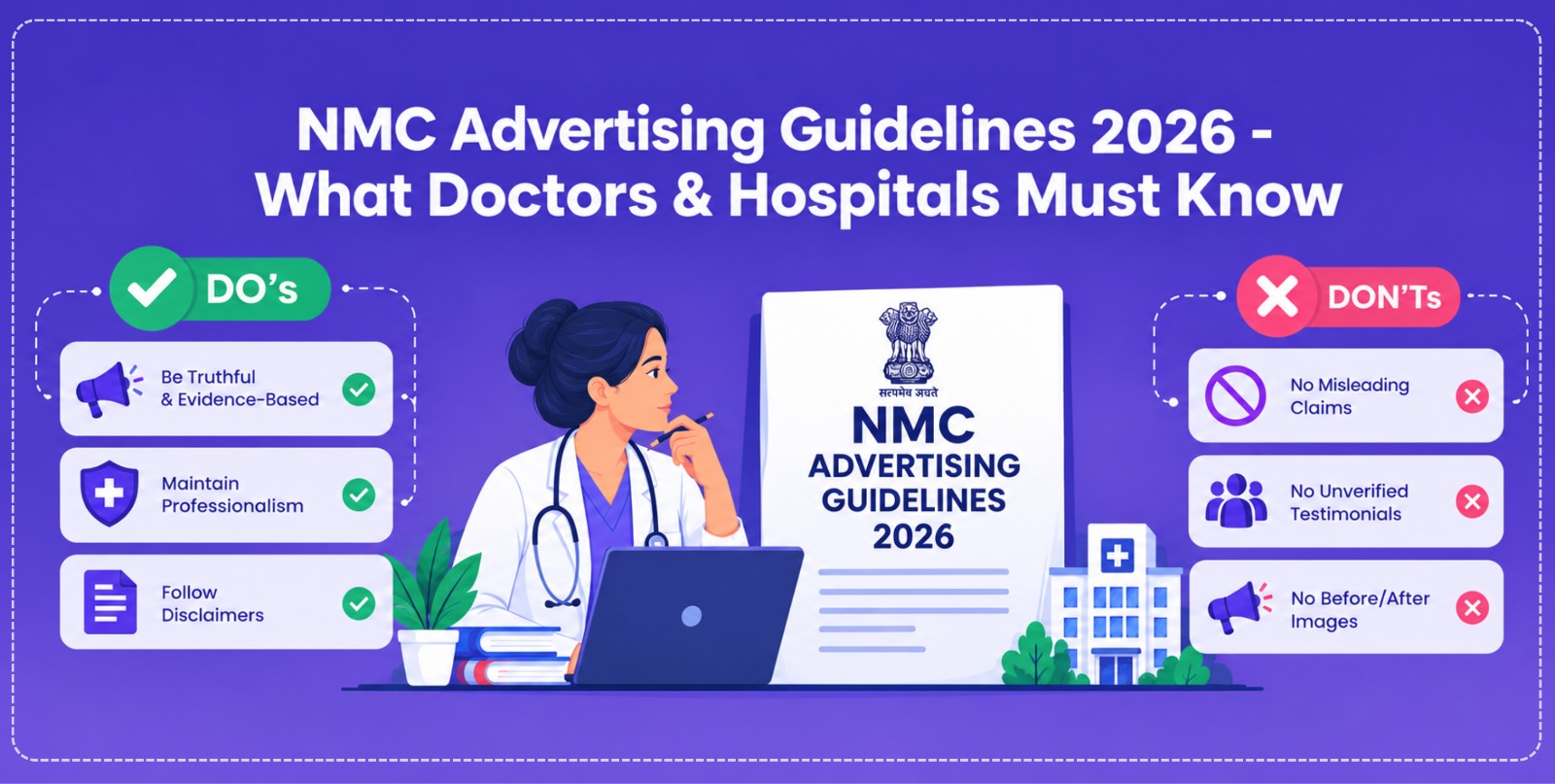
The National Medical Commission (NMC) has released new guidelines on ethical advertising and public communication by doctors, hospitals, and medical institutions. These guidelines bring a change in how healthcare professionals and organizations approach digital marketing, promotions, and public communication.
They affect how healthcare businesses present their services, communicate professional information, manage their online presence, and work with marketing agencies.
For doctors and hospitals, the objective is to maintain an informative digital presence without using misleading claims or prohibited promotional practices. Websites, social media, search engine optimization (SEO), influencer campaigns, patient reviews, and AI-generated content all require careful consideration when used to communicate with the public.
This blog explains the key changes, what healthcare organizations can still publish, which practices to avoid, and how to approach digital marketing within the guidelines.
What are the NMC Advertising Guidelines 2026?
The guidelines regulate advertisements and digital communication in medical practice. They aim to protect patients from false, exaggerated, or unverifiable claims. They also protect patient privacy and the dignity of the profession.
The notice was issued in the context of Supreme Court Writ Petition (Civil) No. 1160/2023. It aims to protect patients from misleading medical claims, preserve professional dignity, and discourage the commercialization of healthcare.
Three terms help explain the guidelines:
- Registered Medical Practitioner (RMP): A medical practitioner registered under the applicable NMC framework and listed in the relevant medical register.
- State Medical Council (SMC): The state-level regulatory body responsible for relevant professional oversight and disciplinary proceedings.
- National Medical Register (NMR): The national register of medical practitioners maintained under the NMC framework.
Key aspects of the guidelines
A broad definition of advertising: Section 3.2 addresses communication that directly or indirectly promotes an RMP’s services, reputation, skills, qualifications, or achievements, or a healthcare institution’s commercial services.
Multiple communication channels: The guidelines cover relevant traditional and digital communication, including websites, social media, blogs, messaging platforms, sponsored content, and influencer-led promotion.
Responsibility for third-party content: Doctors and hospitals must consider the content published on their behalf by agencies, influencers, and other parties, as outlined in Section 4.4.
A distinction between information and promotion: Factual, non-promotional communication differs from content intended to solicit patients or create a misleading impression of professional standing.
The guidelines do not mean that every online communication is prohibited. They require healthcare organizations to consider the content, purpose, and presentation of their communications before publishing them.
What Hospitals and Doctors Can Still Publish?
Good news first. You can still advertise. It’s just that you have to be factual and authentic.
Hospitals can share their name, location, contact details, departments, facilities, equipment, services, emergency care, accreditation, and charges.
A doctor directory on a hospital website is fine. List names, qualifications, specialties, registration details, and availability. The notice sees this as patient information, not an ad.
Equipment news is fine too. Stick to facts. Do not say it is better than others or always accurate.
Doctors can:
- Announce a new practice, a move, a change in practice type, leave, a return, or a fee
- Give public health talks in their own name
- Hand out health education pamphlets to patients
- Publish research case studies in reputed journals
One rule for online posts. Show your name, qualifications, registration status, and SMR/NMR number.
What Is Prohibited – Rules for Every Healthcare Website & Social Page?
Topic | Allowed | Not Allowed |
Services and Equipment | Factual details | Superiority claims or guaranteed outcomes |
Doctor Profiles | Name, qualifications, specialty, registration details | Promotional portrayal of a doctor, self-promotional photos |
Quality Claims | A ranking or award anyone can verify, with method and date | “Best”, “No.1”, “top”, “leading”, “most trusted” without proof |
Awareness Content | Educational talks and information | Fear-based marketing or content that creates unneeded demand |
Fees | Factual, clear charges | Discounts, coupons, contests, cashbacks, or free procedures that push people to unneeded care |
Endorsements | None for promotion | Celebrity, influencer, patient, or employee endorsements |
AI-generated content | Content created with AI that complies with the applicable requirements | Misleading synthetic endorsements, fabricated patient experiences, or false clinical claims |
Patient testimonials | Appropriate patient information that complies with the guidelines | Prohibited promotional testimonials, endorsements, patient success stories, and before-and-after content |
How the Guidelines Affect SEO, Google Listings, and Online Reviews?
The guidelines do not ban SEO or websites. They go after misleading claims and manipulation.
Ethical SEO for Doctors
SEO for doctors can focus on accurate service descriptions, professional qualifications, clinic locations, and consultation information.
Medical SEO can also support educational articles that explain healthcare terminology, describe general procedures, and answer common administrative questions. Content should remain factual and avoid guarantees, unsupported claims, or language that encourages unnecessary treatment (Sections 5.1 and 8.1).
However, improving visibility must not involve misleading claims or prohibited promotional practices. Section 9.4 addresses healthcare platforms that list RMPs, including restrictions on paid doctor rankings and requirements concerning transparent listing practices.
Google Listings & Online Reviews
The guidelines do not prohibit every online review or listing. They restrict fake, paid, or manipulated reviews, ratings, testimonials, and endorsements used for promotion (Sections 8.1(xi)–(xii)).
A practical approach is to keep listings accurate, publish useful information, and review digital content regularly. Search visibility should follow from accessible, factual information rather than misleading representations of professional standing.
AI-Generated Content, Deepfakes & Influencer Marketing
AI can be used to create and edit healthcare content, including educational articles, website copy, social media posts, and informational graphics. The use of AI is not, by itself, a reason to treat content as prohibited. The content and its use must comply with the NMC guidelines.
Section 7.2 addresses AI-generated and AI-assisted promotional content. Healthcare organizations should check the applicable requirements before publishing AI-generated material.
Here are some key considerations:
- Factual accuracy – Review AI-generated content for misleading or unverifiable claims about diagnoses, treatments, outcomes, qualifications, or healthcare services.
- AI-origin marking – Apply the specified marking to AI-generated promotional content where required by the notice.
- Patient privacy – Do not enter or expose patient information through AI tools in ways that breach confidentiality
- Human review – Have an appropriate person review the content before publication.
Influencer marketing also requires careful consideration. Sections 8.1(ii) and 8.1(xi) restrict prohibited endorsements and testimonials, including those involving third parties.
Doctors and hospitals should not assume that a campaign becomes acceptable simply because an agency, influencer, or AI tool created it. The purpose, claims, and presentation must all be assessed against the applicable rules.
Patient Privacy, Consent & Data Protection
Patient data needs the most care.
- Patient details, photos, videos, records, and clinical images cannot appear in ads unless the law allows it and the right consent exists
- Consent does not fix a banned practice. A testimonial or before-and-after image stays banned, even with consent.
- Where consent is needed, it must be specific, informed, voluntary, written down, and verifiable.
- Blur or crop faces, birthmarks, and other marks that can identify a patient
- Do not share names, faces, or other details that can identify a patient
- Personal data must follow the IT Act, 2000, and the Digital Personal Data Protection Act, 2023, and their rules.
Healthcare businesses should therefore review website enquiry forms, appointment systems, healthcare CRM software, and other platforms that process patient information.
Penalties & Appeals
The State Medical Council (SMC) acts against a doctor under the NMC Act. The notice says the SMC may contemplate graded action.
Stage | Action the SMC may contemplate |
First violation | Warning and mandatory ethics training |
Second violation | Censure and monetary penalty |
Third violation | Suspension of registration for 3-6 months |
Serious violation (misleading cure claims, inducement, digital mass solicitation) | Suspension for 6-12 months |
Repeated violations | Removal from the medical register for 1-3 years |
A penalty may follow only after a show-cause notice and a chance to reply. The SMC must give a reasoned order.
A doctor may appeal to the Ethics and Medical Registration Board (EMRB) of the NMC within 60 days. A second appeal may follow within 60 days. Hospitals follow the Clinical Establishments Act or State Act.
Compliance Checklist – Audit Your Hospital or Clinic Website in 10 Steps
- Remove superiority words like “best,” “No. 1,” and “top.”
- Delete guarantees such as guaranteed cure or painless treatment
- Check each doctor page for name, qualifications, registration status, and SMR/NMR number
- Remove promotional doctor photos and self-praise
- Review offers, discounts, coupons, and free procedures
- Label AI content. Delete fake patient content.
- Check agency contracts for pay-per-patient or lead fees.
- Confirm consent and privacy steps for patient data.
- Look for bought or faked reviews, followers, and rankings.
How Eiosys Helps Medical Businesses Stay Compliant & Visible?
Healthcare businesses need a digital presence that is informative, technically reliable, and aligned with applicable requirements. Eiosys provides website development, maintenance, and digital marketing services that can support these operational needs.
The scope of any engagement should be agreed with the healthcare organisation, with regulatory decisions reviewed by its appropriate legal or compliance adviser.
Website Development & Maintenance
A well-maintained website helps hospitals keep their contact details, doctor directories, service descriptions, and fee information current.
Eiosys offers hospital and doctor website development and website maintenance services that can support content updates, technical maintenance, and security reviews.
SEO, AEO, and GEO
SEO, answer engine optimization (AEO), and generative engine optimization (GEO) can help make factual healthcare information easier to discover.
For medical businesses, this can involve educational content, accurate metadata, appropriate structured data, and local SEO. All content and optimization practices should remain within the applicable guidelines, without misleading claims, prohibited solicitation, or promises of rankings.
Eiosys offers NMC guidelines-compliant SEO services for doctors. Today, it works with 15+ healthcare brands and private practitioners and has delivered great results in terms of boost in brand visibility, lead generate and overall revenue growth.
Patient Management & Hospital Software
Custom healthcare CRM software and patient management software can help organizations maintain appointment records, track consent where required, and send non-promotional appointment reminders.
Hospital management software and healthcare ERP systems can also support administrative workflows, billing records, and operational transparency. Where relevant, healthcare businesses can evaluate ABDM-compliant software against their actual technical, regulatory, and operational requirements.
Software implementation alone does not establish compliance. Organizations must configure systems appropriately, manage access responsibly, and follow applicable data-protection requirements.
Conclusion
The rule is simple: educate and inform; do not promote. The NMC advertising guidelines 2026 do not stop doctors from being found online. They stop promotional claims, solicitation, and manipulation. Good digital marketing for doctors stays on the right side of that line.
Disclaimer: This article is intended for informational purposes only and is based on NMC Public Notice No. R-13014/01/2024-Ethics dated 23 October 2026. It does not constitute legal advice. Please consult your legal adviser or State Medical Council for guidance specific to your circumstances.
Frequently Asked Questions
The notice states that the guidelines came into effect immediately upon issuance. Healthcare organizations should therefore review existing content rather than assume that older material is automatically exempt.
The hospital should verify the content’s accuracy, check for misleading claims, assess patient data exposure, and confirm whether the notice requires AI-origin marking. It should also review the content’s purpose and presentation, because AI-generated material can still constitute advertising. Section 7.2 should be consulted for the applicable requirements.
Yes, they can, as reminders serve a different purpose from promotional campaigns. Healthcare organizations should keep such messages factual, relevant, and non-promotional. Messages should not disclose sensitive patient information unnecessarily. Relevant considerations include Sections 6.1–6.4 and 7.6.